
Fifteen Buildings at 1:500: Architecture Models Have Taken Over Our Queue

Client
School of Explorative Architecture
Something has shifted in our print queue. A steady stream of architecture students — most of them from the School of Explorative Architecture here in Cape Town — have been sending us their project models to print. We've done more than fifteen of them now, nearly all at 1:500, and they've quietly become the biggest single thing running across our machines.
We're glad they found us. We also badly underestimated what fifteen buildings would do to a six-printer studio. Here's the honest version of both.
1:500 is smaller than it sounds
Scale is where these jobs are won or lost, and 1:500 is unforgiving.
At that ratio, a 20-metre building lands at 40mm tall — about the height of a matchbox. A standard 3-metre floor-to-floor becomes 6mm. A 200mm external wall becomes 0.4mm, which is exactly one pass of our standard nozzle. And a 100mm internal partition becomes 0.2mm: thinner than a single extruded line, which means the slicer either quietly fattens it up or drops it from the print entirely.
So the first thing we do with a student model isn't slice it. It's go looking for what still physically exists at that size — balustrades, mullions, stair treads, window reveals — and tell you which details are going to survive and which ones are about to vanish. That conversation is much cheaper before the print than after it.
Orientation is most of the job
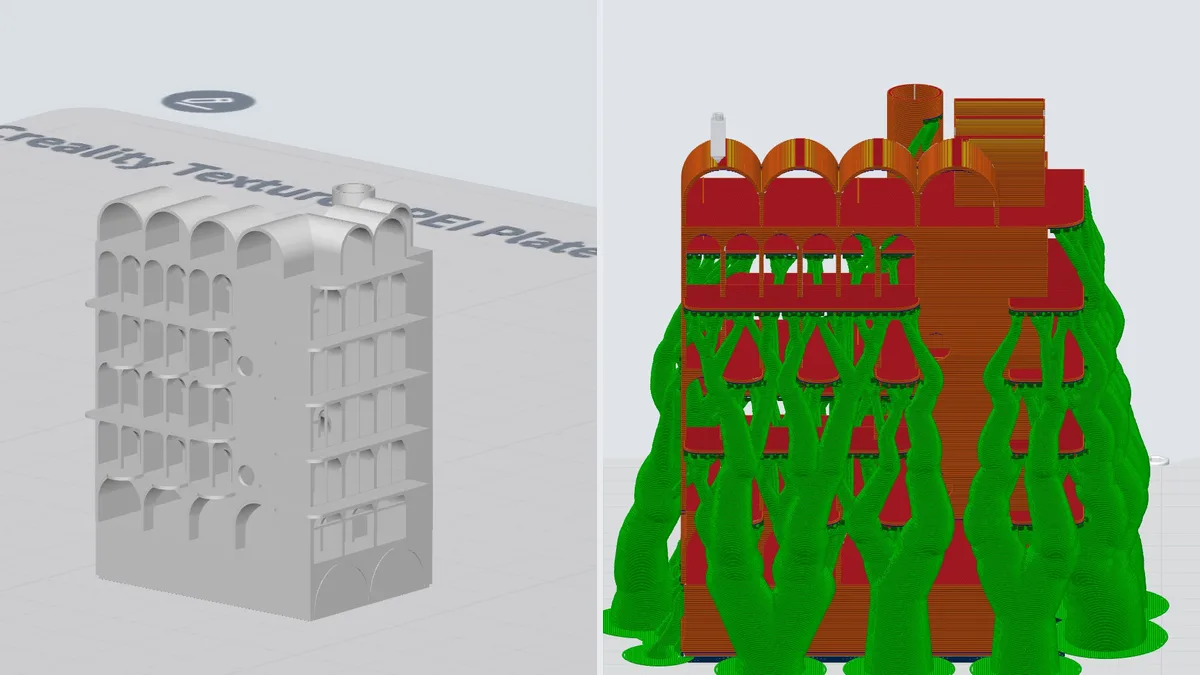
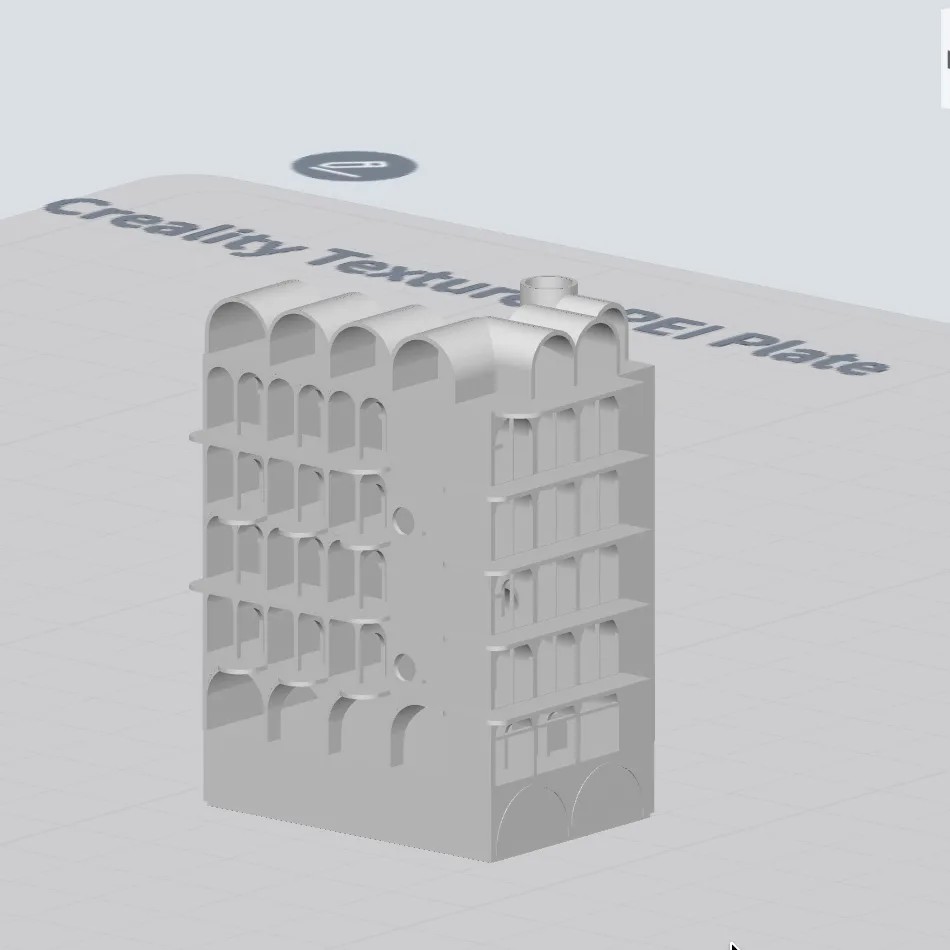
The model above is a good example of what keeps arriving: rows of arched openings stacked over five floors, slabs cantilevering out the sides, a circular core running up through the middle.
Lying flat on the plate, all those arches become bridges printed into open air. Stood upright, each arch turns into an overhang the printer can build up to gradually — and the cantilevered slabs become the problem instead. There's no orientation that makes a building easy. There's only the one that moves the difficulty somewhere you can support it.
The support forest
Then the supports go in, and the plate stops looking like architecture.
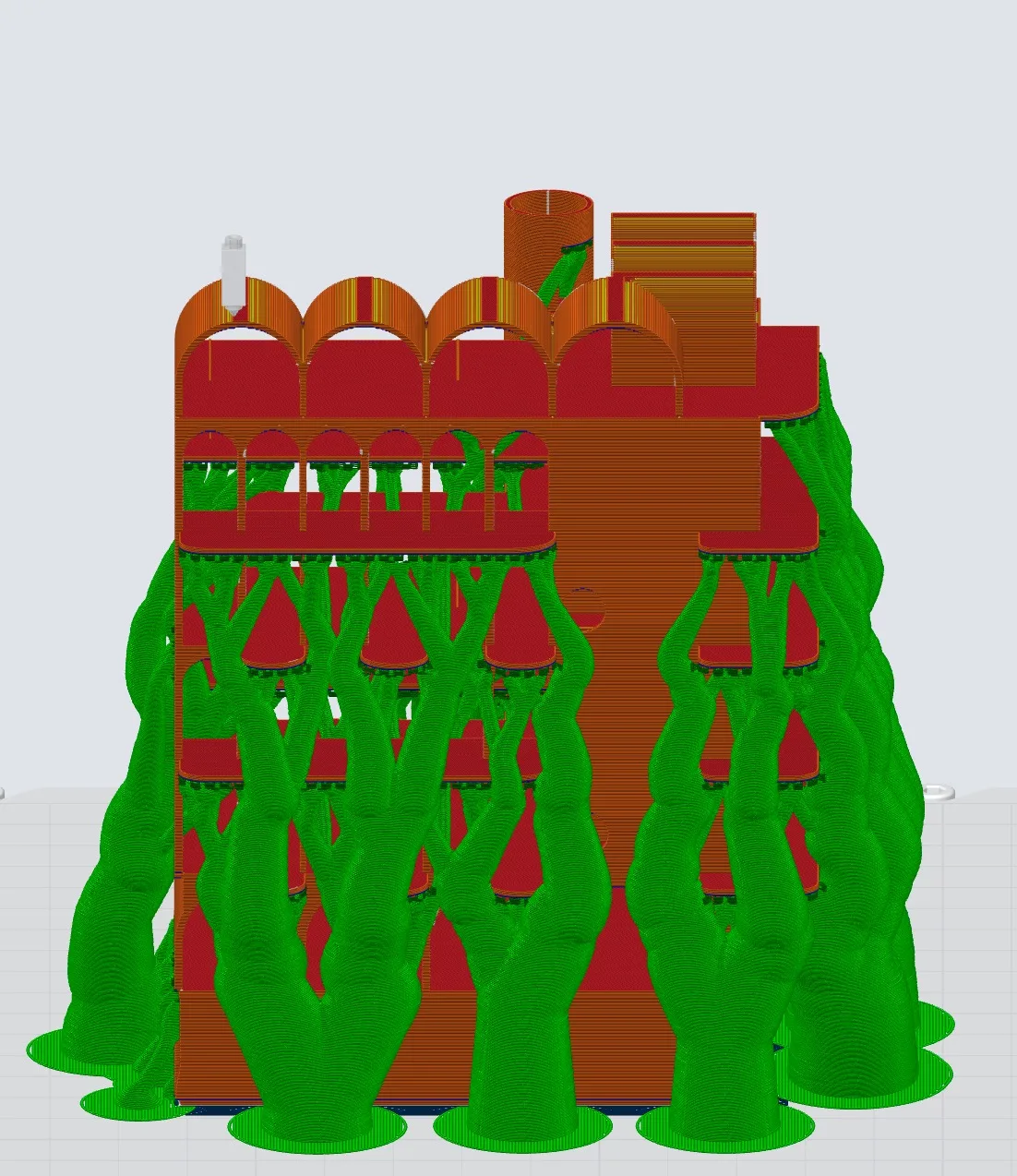
Everything green here is scaffolding, not building. Every projecting slab needs something underneath it, and because the slabs repeat on every floor, the supports grow into a thicket that wraps the whole model. On prints like this one, the supports use about as much plastic as the building does.
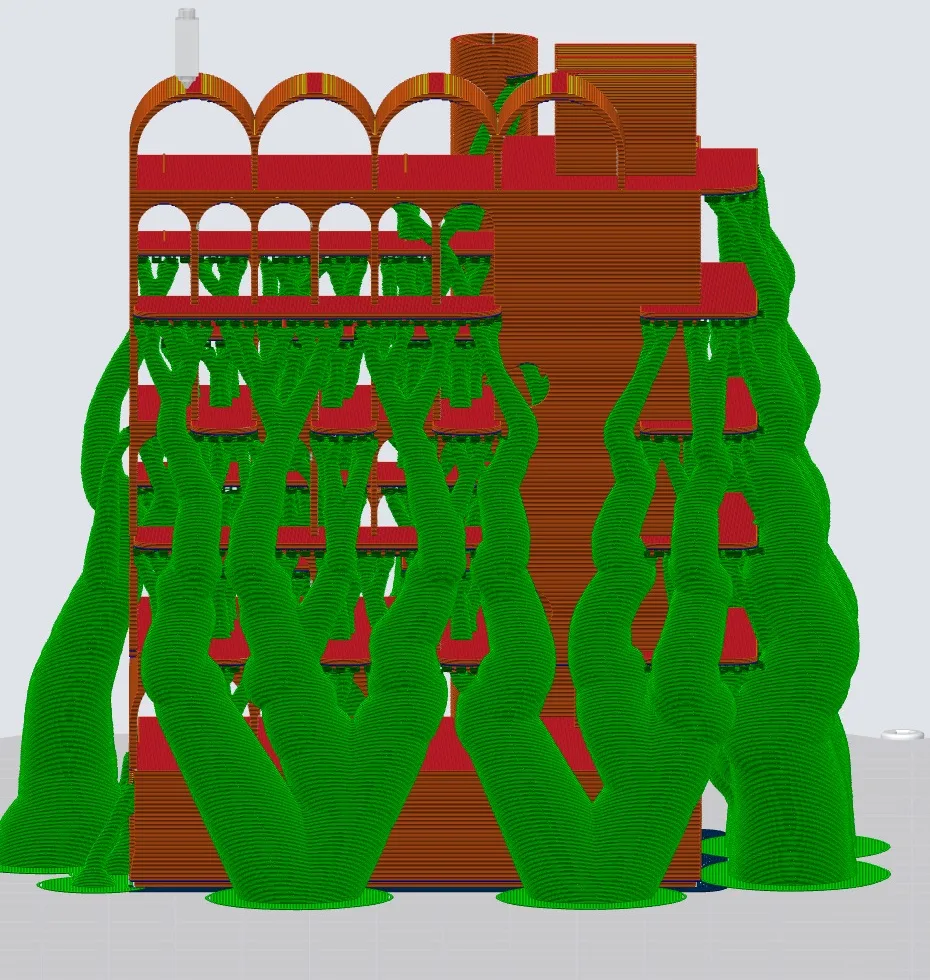
And all of it has to come back off afterwards. At 1:500, a balcony is a couple of millimetres of plastic — so support removal here is tweezers, good light and patience, not pliers. It's the slowest part of the job, and it's the part that decides whether the model shows up to a crit looking sharp or looking chewed.
What fifteen of them has done to our capacity
We run six printers: three Creality Hi Combos, a K1 Max and a K2 Plus on production, plus a Bambu Lab A1 Mini we keep for test prints. You can see the whole lineup on our printer fleet page, and we wrote about how we use them here.
Six printers sounds like plenty until the work changes shape. A batch of keyrings shares a plate. A building doesn't — it takes the whole bed, it runs long, and it runs long again if a support fails halfway up and we restart it. The A1 Mini is no help here either; it's a small machine for checking a part before we commit to it, not somewhere to park a building. So fifteen architecture models isn't fifteen quick jobs — it's five production beds tied up in rotation, which pushes everything else in the queue back.
We've kept up, but not without pressure, and we'd rather say that plainly than quietly stretch everyone's lead times. It's also why we're now asking architecture students for more notice than we used to.
If you're about to send us one
A few things that make a real difference to what we can promise you:
- Send the file before crit week, not during it. The week before a hand-in is when every student in the year has the same idea at the same time.
- Tell us your actual deadline up front. Not "soon" — the date. It changes how we schedule the plate.
- Check your details at scale. Anything thinner than about 0.4mm at final size is at risk. If it matters to the design, thicken it in the model or accept that it won't print.
- Ask before you scale up. Going from 1:500 to 1:200 isn't a slider — it's a different print, a different plate, and a different price.
- Send a clean, watertight mesh. Our file guide covers what we need and what tends to break.
If you're not sure whether your model is printable, send it anyway and ask. We'd rather look at it early than diagnose it the night before your submission.
Ready to print your project?
Students get up to 25% off with us, architecture models included. Send us a WhatsApp or email create@forgeandfigures.co.za with your file, your scale and your deadline, and we'll tell you honestly what it'll take.